

Have you wondered why your job hunting is taking you so long – months or even years, and still not landing you a job?
Most job seekers send out several applications initially but soon stop working on them when they fail to see results within a few days or weeks.
The problem is usually the incorrect expectations of the time frame. Once applicants start applying for jobs, they think they will land a job within a few days or weeks, which might not always be true.
So how much time does it take to find a job?
On average, getting a job takes around 3 to 7 months. This can vary based on the economic conditions of the country/state, the demand and supply of jobs in that industry, your urgency/deadline, and your current employment status.
If you want to know how to reduce the time it takes to find a job, you’ll need to understand the factors that influence the duration of the job hunt. In this article, we dive into these factors to shorten the duration of your job hunt.
Factors That Influence The Time To Find A Job
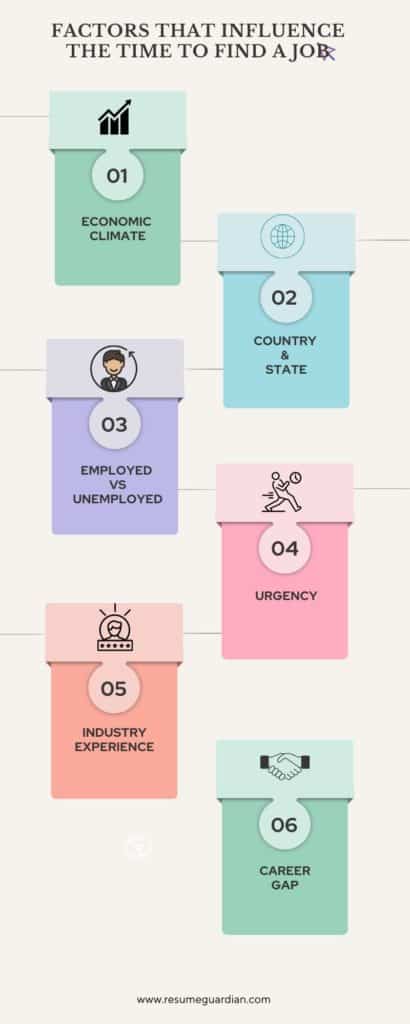
Many factors could determine how much time it’s going to take you to land a job.
We will go through these factors in this article.
Economic Climate – Growth/Recession Enhances/Diminishes Opportunities To Find Jobs

The current economic climate plays a crucial role in determining how long you would take to find a job.
In general, if the economy is flourishing, businesses will expand with many new projects and creates lots of job openings. Companies would desperately be looking for candidates to fill the roles, and you would be able to get a job pretty fast.
On the other hand, if there’s an ongoing recession, businesses, in general, would be down. Companies would focus more on cutting costs to sustain yearly revenue forecasts, resulting in layoffs and job cuts.
If you’re unlucky and your job hunt timing coincides with the recession, then be prepared for a prolonged job hunt period.
Being positive, motivated and focused on what you can control rather than what you can’t, can greatly help you achieve your goals despite the challenges.
Job Opportunities Varies With The Country And State You’re Applying For Jobs

Different countries have different job opportunities, and depending upon the industry you’re applying for, there could be significant differences in the job availability of that market.
For instance, if you are in the Technology space, more job openings are available in the USA (Silicon Valley) compared to Australia (Sydney). But if you’re looking for jobs in the mining industry, Australia (Sydney) has more openings than the USA (Silicon Valley).
Job openings also vary depending on the state you’re applying for jobs. Again, if you’re looking for jobs in the technology space, Silicon Valley (CA) has more openings than Houston (TX).
Based on your state/country, do an assessment of how many new job openings gets posted daily, in order to get a realistic estimate of how long it’s going to take you to find a job.
Are You Currently Employed Or Unemployed When Job Hunting?

Finding a new job when you’re currently employed is always easier. There are several reasons why this is true.
- First is your value. Recruiters know that you’re valuable to the current marketplace and you provide value to your current employer. Recruiters are willing to give you a better deal to get you on board because your value is proven.
- The second is your mindset. You don’t have a do-or-die situation if you already have a job. This makes you look naturally confident during interviews, compared to someone desperate to get that job to pay the bills.
Having said that, being unemployed during a job hunt is not all negative. There are also some serious advantages if you’re unemployed when job hunting.
- First is the drive and commitment of an unemployed person. If you don’t have a job, you’ve time-bound targets to return to the marketplace. For someone already employed, it’s not easy to commit to time-bound goals to find another job.
- Secondly, you have plenty of time to prepare and apply for jobs if you’re jobless. For someone working a full day, a lack of time to prepare and apply for jobs can be a serious disadvantage.
Being already employed during job hunt can enhance your prospects from recruiters perspective, but being unemployed can give you an edge in terms of time, preparedness and achieving time-bound targets.
Urgency To Find A New Job Is A Critical Factor That Determines The Duration Of Your Job Hunt

Do you have a real urgency to find a new job?
Though it’s a simple question to find your real intention, it’s the most important question you must ask yourself before you start job hunting.
Assess if you’re only casually job hunting, meaning you try to look for job openings when you have a bad day at the office or when you feel like looking for openings once a month or two. If that’s your situation, your job hunt could take years and still not land you a job.
Urgency and intent are critical to shortening your job hunt’s duration. Many factors decide whether you have a real urgency to find a job.
Let’s go through a few real-life situations:
- Situation-1: You’re currently jobless. You have an urgency and a real need. The monthly bills are real, and you’ve to make payments for these bills. So you have a time-bound deadline within which you need to find a new job.
- Situation-2: You migrated to a new country and started afresh. You might have saved up to cover an initial 4-6 months of expenses without a job. In this situation, you also have a real urgency and a time-bound deadline for finding a job.
- Situation-3: You are currently employed but hate every minute of your job, or you’ve very high-stress levels affecting your health. Even though this situation demands urgency to find a new job, I have seen many people getting stuck in a similar situation for up to 10 years or more. They earnestly try for a job change but see no progress. This is a classic situation where you have a real need that does not translate to a time-bound deadline.
- Situation-4: You’re jobless but don’t like working in a corporate setting. You might be interested in freelancing or generating online income, but your family pressures you to get into the workforce and find a normal office job to pay the bills. Subconsciously, since you don’t perceive this situation as urgent, your job hunt could continue for a prolonged time.
Any situation is urgent only if it’s deemed “urgent” by you. Urgency creates time-bound deadlines and pushes you for consistent daily action.
Your Prior Experience In The Industry Can Affect Your Job Hunt Duration

If you’re in an industry that requires specific technical skills and specialized knowledge, having relevant experience can be crucial to speed up your job search.
Domain knowledge and industry experience take years of hard work to acquire. Some recruiters are willing to train people who might not have the experience but have the right attitude to learn. But that’s not always the case.
Usually, the job openings are for projects that need to be executed urgently, and recruiters might be looking for someone with prior relevant experience who could be productive from Day 1, with minimal training or supervision.
How can you turn this situation to your advantage?
- When job hunting, look for job openings that are highly relevant to your current skillsets and that match your prior job experience.
- If you’re trying for a role change or industry change, you can’t set a time-bound deadline because you don’t have the relevant work experience. Stick to your current role for now. Once you start working in the organization, you could explore internal roles within the company and plan for a gradual change.
If you’re in urgent need of a job, your best bet is to apply for job openings where you’ve relevant prior experience.
Career Gaps In Your Work Experience May Impact Your Job Search Duration

Career gaps are not always a bad thing. It’s quite common nowadays to take some time off for reasons like having a baby, full-time studying, or due to health reasons or getting burnt out in work, or to even take time off to focus on your other passions in life.
Don’t try to hide career gaps in your resume by altering dates. This would anyway surface during the background checks when you get the offer.
You need to have some reasons ready when asked about your career gaps. Simply be creative and honest when communicating your career gaps to the recruiter.
Don’t worry about career gaps in your resume. When you get shortlisted for interview, you just need to be open and explain the gaps honestly to the recruiter.
Recruiters nowadays are not worried about career gaps because taking time off is becoming the norm in a person’s work life. Recruiters are more interested to know about your work when you were previously employed and the reasons for gaps.
Having said that, you might still come across recruiters who would put aside resumes with career gaps. This depends on demand and supply – the number of job openings vs the number of candidates applying for the job.
Now that you’re aware of various factors that could directly or indirectly impact your job search duration let’s go through the action steps you could take to reduce the time to grab that job offer.
How To Reduce The Time It Takes For Job Search?

- Be aware of the economic climate when you’re looking for a job. Set realistic expectations on timelines in case your job hunt coincides with a recession or economic slowdown.
- Make your job search activity your current job. Treat this as a 6-month project.
- Be consistent in your job search efforts – take action daily (at least 1 hour daily) to achieve your target.
- Scan daily for new job openings posted in your industry.
- Create a daily shortlist of the most relevant job openings.
- Tailor your resume individually for each job opening, and create a cover letter for each application.
- Set up alerts and notifications in online job portals for tailored job searches.
- Send out at least 3 applications daily, with customized resumes and cover letters. Applying for 3 jobs with a customized resume is a far better approach than sending out a general resume version for 20 job openings.
- Create an Excel tracker to keep track of all jobs applied. Also, attach the resume versions and cover letter in the tracker for easy reference later on.
- Parallelly, keep preparing for your interview daily. Don’t leave this until the last minute or until when you get an interview call.
- If you’re currently employed, understand that your subconscious may work against you to sabotage your job hunt efforts. Create your own personal urgency and time-bound deadlines.
- If you’re currently unemployed, urgency and deadlines will come naturally. But you’ll have to work on keeping calm and having patience. Work consistently to achieve your daily targets to apply for jobs.
- In addition to applying to jobs via online job portals, contact your networks. Target to talk to at least one person daily from your network of previous colleagues, friends, and family.
- If you’ve time to spare, work on your personal projects, apply the new skills you learned, and showcase them as real projects in your portfolio. This would enhance your chances of standing out from the crowd.
Final Thoughts
Job hunting, for sure, could be a depressing phase, because you might have applied for lots of jobs, but the responses you received might be miniscule. It’s natural to feel undervalued and under-appreciated, but don’t despair and give up, just keep going and take consistent action on a daily basis. Eventually you’ll get that job, and your efforts will all be worth it.